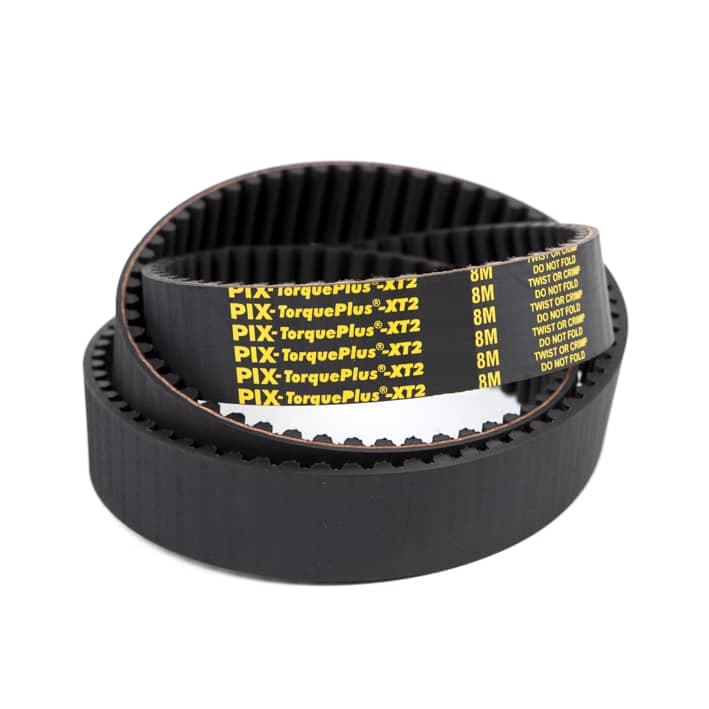
Double sided timing belt

How Much Does a Timing Belt Cost?

Timing belts are essential components in a wide range of machinery for keeping moving parts in sync. Without them, many machines, from conveyor systems and packaging equipment to lawn mowers and automotive applications, simply wouldn’t work.

How much does a timing belt cost? This can vary widely depending on the type of belt you need, its size and where it will be installed. There are no one-size-fits-all timing belts, so it’s important to understand what affects pricing before you make a purchase.

In this guide, from the experts at The Bearing Company, we’re looking at what influences the price of timing belts and how you can ensure you get the right one for your application.

WHAT IS A TIMING BELT?

A timing belt is a kind of machinery belt that features ‘teeth’ that fit into notches on a series of pulleys within a piece of equipment. Because each pulley is notched, the belt can keep different parts of the same machine working completely in sync, hence a ‘timing’ belt. It’s very similar to how a chain works. They prevent slippage and ensure accurate, consistent movement, which is essential for precision.

They are widely used across machinery, including conveyor systems, packaging equipment and automated production lines, as well as in engines and other industrial equipment. We supply a wide range of timing belts to suit different applications, sizes and specifications. For a more detailed look at how timing belts work, please take a look at our full timing belt guide.

USES OF TIMING BELTS

Timing belts are used across many industries where precise, reliable power transmission is essential. Their design makes them ideal for applications that require accurate synchronisation. Some common uses include:

· Conveyor Systems: Moving products efficiently through production lines.
· Packaging Machinery: Accurate timing during sealing, cutting and filling.
· CNC Machines: Precise, repeatable movement in cutting and machining.
· Automatic Equipment/Robotics: For precision in repetitive processes.
· Textile Machinery: Supporting consistent, high-speed operation.
· Engines and Small Machines: Keeping vital components working in sync.

Because of their versatility, timing belts are vital across both large-scale industrial and smaller-scale applications.

HOW MUCH DOES A TIMING BELT COST?

Timing belt costs can vary significantly based on the type, size and application. There’s no fixed price, as different machines require different specifications, from small, lightweight belts to larger, heavy-duty options designed for high-load applications.

By way of example, across our wide range, timing belts can cost anywhere from £1.53 up to £584.52. Smaller belts, such as 5M timing belts, typically range from £1.58 to £27.20, making them a cost-effective option for lighter use. More specialised options, such as double-sided timing belts, range from £42.08 to £98.96, while larger 14M timing belts can reach up to £584.52 for heavy-duty use.

Generally, the larger and more robust the belt, the higher the cost will be. Choosing the right spec is key to ensuring reliable performance.

PIX BELTS TIMING AND LAWN GARDEN

WHEN SHOULD YOU REPLACE A TIMING BELT?

Replacement intervals for timing belts will vary depending on the application and how they are used. Factors such as load, operating speed, environment and frequency of use will all affect how quickly a belt wears out.

To ensure you neither replace your belts too often nor let them wear out to the point machinery could be damaged, inspect them regularly and replace them at the first sign of wear. High-use, high-load or harsh environment usage may mean more frequent checks are required, while lighter applications will likely have longer service intervals.

Following the manufacturer’s guidance, where available, is always recommended.

SIGNS YOU SHOULD REPLACE YOUR TIMING BELT

So what should you look for during a timing belt inspection? These are some of the signs that indicate a belt may be worn and due for replacement:

· Cracking or Surface Damage: Visible cracks along the belt indicate fatigue and could even indicate imminent risk of failure.
· Fraying Edges: Worn or frayed edges suggest the belt is beginning to degrade or is misaligned on its path.
· Damaged or Missing Teeth: Teeth that are worn down or missing entirely can affect timing accuracy and overall performance.
· Glazing or Shiny Surfaces: A polished appearance often means the belt has overheated, which could cause it to lose grip.
· Unusual Noise or Vibration: Squealing or irregular movement can indicate slipping or poor tension on the belt.
· Loss of Performance: Reduced efficiency or inconsistent operation also indicates the belt could be worn and in need of attention.

If any of these issues are spotted during an inspection, replacing the belt promptly will help avoid further damage and total belt failure.

Double sided timing belt

HOW TO AVOID TIMING BELT FAILURE

Preventing timing belt failure is all down to a regular inspection schedule, proactive maintenance and correct usage. Inspect your belts often for early signs of wear, ensure they are properly tensioned and aligned and keep machines and working areas clean from any debris. Always use the correct belt for your application, as a poor fit or low-quality belt can lead to premature failure.

TIMING BELTS AT THE BEARING COMPANY

We hope we’ve been able to provide some guidance on how much a timing belt costs, along with advice on getting the most out of your belts and ensuring you know when to replace them. We have over 50 years of experience with belts, from timing belts to OEM belts, automotive belts, multi-ribbed belts, polyflex belts and lawn mower belts.

If you’re ready to find the right belt for your application, browse our range and shop now. If you have a question or need help finding the right belt for your application, just get in touch with us on 01527 509620, email sales@thebearingcompany.co.uk or use our online contact form. We’ll source the exact belt you need, and offer next-day delivery options and free delivery on orders over £50.

Tapered Bore Bearinng Insert UK

What is a Bearing Insert and Why is it Essential for Machinery?

A bearing insert is a self-contained ball bearing that works on a radial axis and is a specialised component that is designed to be inserted into various housings like a flange or pillow block. They are essentially an adapted version of a deep-groove ball bearing and are often considered the “bread and butter of the machine industry”, solving a variety of engineering challenges. This blog post will go further into detail and tell you everything you need to know about what a bearing insert is.

WHAT ARE BEARING INSERTS?

An insert bearing is an essential component in a variety of machine types and industries. They are essentially an adapted deep-groove ball bearing and have a spherical outer ring, an extended inner ring, integrated sealing and a secure locking mechanism. They are important components, as they combine fast installation with high-load capacity and the ability to self-align even in harsh, high-vibration environments.

There are many types of insert bearings, and here at The Bearing Company we endeavour to provide a wide variety of options that should fit whatever project you are working on. There are bearing inserts, tapered bore bearing inserts, screw flat back inserts and screw locking inserts in our comprehensive range.

Tapered Bore Bearinng Insert UK

HOW DO BEARING INSERTS WORK?

You should now know what a bearing insert is, so next you will need to know how they work. These specialised radial bearings are designed to fit exactly into housings for easier installation and will also allow for slight misalignment and corrections. The primary aspect of how they work is that they provide a low-friction surface for shafts to rotate on while locking into place with setscrews or locking collars. There are also fully sealed designs that are protected against external contaminants.

This design functions via rolling elements (like balls) that reduce friction between the set housing and the inserted shaft to support both thrust, axial and radial loads. This allows for clean, efficient movement while also keeping the application stable and working correctly.

Bearing insert Flat Back - Shaft Eccentric Collar

WHERE ARE BEARING INSERTS USED?

Bearing inserts are typically used across a wide range of industries to support rotating shafts and reduce friction in machinery. Common applications include:

  • Agricultural equipment (tractors, harvesters, ploughs)
  • Conveyor systems in manufacturing and logistics
  • HVAC systems (fans and motors)
  • Food processing and packaging machinery
  • Mining and construction equipment
  • Textile and paper processing machines
  • Automotive components
  • Assembly lines
  • Marine equipment and ship machinery
  • Pumps, compressors and electric motors

These inserts are especially valued in environments requiring easy installation, reliable performance and efficient load handling.

BENEFITS OF BEARING INSERTS

Bearing inserts offer a range of both practical and performance advantages, which has made them a popular choice across many industries. Two of their main benefits are ease of installation and simple maintenance. They are designed for quick fitting, removal and eventual replacement. These benefits help minimise downtime and reduce overall labour costs in busy operational environments.

They are also a highly cost-effective component option, providing excellent long-term value through a combination of affordable upfront pricing, impressive durability and reduced maintenance needs. Manufactured from robust materials, bearing inserts are built to handle heavy loads, vibration and demanding conditions, ensuring reliable performance over time.

A further benefit of an insert bearing is its capacity to tolerate slight shaft misalignment. This self-aligning feature helps minimise component wear and enhances overall system performance. They also enable smooth, low-friction rotation, which contributes to reduced energy usage and lower heat build-up during operation.

Finally, bearing inserts are highly versatile and can be used across a broad range of applications. With options available in different sizes, materials and even locking methods, they can be tailored to suit specific machinery needs. Their sealed or shielded designs also help keep out contaminants, supporting longer service intervals and reduced maintenance requirements.

Locknut With Nylon Insert

PRODUCT SPECIFICATIONS OF BEARING INSERTS

Bearing inserts are available in a wide range of specifications to suit different applications and operating conditions. They typically feature an inner ring, outer ring, rolling elements and sealing options designed for durability and smooth rotation. Common bore sizes range from small diameters for light-duty use to larger sizes for heavy industrial machinery.

These inserts are often manufactured from high-grade steel for strength and wear resistance, with options for stainless steel in corrosive environments. They are available with various locking mechanisms, such as grub screws or adapter sleeves, to ensure secure shaft attachment. Many bearing inserts also include rubber seals or metal shields to protect against dust, moisture and contaminants, helping to extend service life and maintain performance.

Regardless of the project, environment or other specification, there is sure to be an insert bearing that is ideal for your needs.

WHAT IS THE DIFFERENCE BETWEEN BALL BEARING INSERTS AND FLANGE BEARING INSERTS?

You have the answer to the question, what is a bearing insert? Now you will need to know how the ball bearing inserts differ from the flange bearing ones.

Ball bearing inserts are standalone units designed to fit into various housings, offering flexibility and stronger self-aligning capabilities to handle slight shaft misalignment. They primarily focus on reducing friction and supporting smooth rotation in a wide range of applications.

In contrast, flange bearing inserts include an integrated flange with bolt holes, allowing them to be mounted directly onto a flat surface. This design is ideal for projects that need more secure positioning, improved load distribution and easier installation in fixed locations.

In short, ball bearing inserts prioritise flexibility and alignment, while flange bearing inserts are designed for stable mounting.

UC BEARING INSERT

SHOP BEARING INSERTS AT THE BEARING COMPANY

What is a bearing insert? They are essential components that support rotating shafts, reduce friction and work to enhance the efficiency and operational lifespan of machinery. Their self-aligning capability, durability and low-maintenance design make them ideal for a wide range of applications across various industries.

At The Bearing Company, our customers benefit from high-quality, reliable products with fast delivery and expert support from our team with over 50 years in the business. Shopping with us ensures you get durable bearing inserts in whatever specification you require. Various sizes, materials and mounting styles, including ball bearing and flange inserts, are all available here.

As well as our comprehensive range of bearing inserts, The Bearing Company offers other crucial components like housed bearing units, pressed steel housed bearing units and many more quality bearings, making us the one-stop shop for all your bearing needs.

754-0151 MTD Lawnflite Belt Kevlar (A7540151)

When to Replace a Lawn Mower Belt

Belts are an integral part of your lawn mower, as they transfer power from the motor or engine to the blades. Without them, the mower simply doesn’t work. They do their job well, but as with all moving parts, they eventually wear out. It’s not always easy to spot when to replace a lawn mower belt, but a tired, failing belt will begin to affect cutting performance, may cause slipping and, left unchecked, will eventually fail altogether.

At The Bearing Company, we have years of experience dealing with lawn mower belts, so we’ve put together this simple guide to lawn mower belts, how long they last, key signs to look for when they need replacing and how to keep your mower working at its best.

754-0280 MTD Lawnflite Belt

WHAT ARE MOWER BELTS AND WHAT DO THEY DO?

Mower belts connect the various parts of your machine, ensuring power from the engine or motor reaches the blades, wheels and other key parts of the mower. Depending on your model, your mower could have multiple belts, such as drive belts for movement and deck belts for the actual cutting blades. Failing and broken belts will cause your mower to lose power, not cut properly and even break down altogether.

The main reasons for belt failure over time are wear from tension and debris, exposure to heat and constant movement when in use. It’s entirely normal for belts to wear out, and it’s vital to replace them in good time to keep your mower working efficiently.

Getting the right shape, size and quality of belt is also essential. We stock and supply a wide range of lawn mower belts for a vast number of brands and models, and our experts are always on hand to help you find the right one for your machine. Just some of the OEM (original equipment manufacturer) quality belts we supply include Black & Decker belts, Honda belts, Gates belts and John Deere belts.

HOW OFTEN SHOULD YOU REPLACE YOUR MOWER BELT?

Knowing when to replace a lawn mower belt largely comes down to how you use your mower and the conditions you use it in. If you’re mowing at home, you’ll be using your machine a lot less than if you run a mowing business or use commercial mowers as part of your job.

Consider frequency of use, whether your mowing is light- or heavy-duty, the conditions you’re mowing in (is it regularly wet, debris-heavy or on uneven terrain, for example) and even consider how long previous belts have lasted, and whether they may be of inferior quality.

For domestic use, belts should be checked at least once a year for wear and tear, while commercial mowers should be checked every ten to twenty hours of operation, as a rough guide. Belts will typically need replacing every 100 to 150 hours of use. That said, regular visual inspections are more important than just changing the belt after a set amount of time.

754-04175 MTD Lawnflite Belt Kevlar (A-75404175)

SIGNS YOUR MOWER BELT NEEDS REPLACING

There are several signs to look for that indicate your belt may be about to fail. The following can all indicate that your belt is wearing out and needs replacing:

  • Visible Cracks or Damage: Check the surface of the belt for cracks, fraying or worn edges. Even small signs of damage can indicate imminent failure.
  • Shiny or Glazed Appearance: A belt that looks smooth or polished may have overheated and lost grip, reducing performance.
  • Slipping or Loss of Power: If your mower struggles to cut or move properly, the belt may be slipping and not transferring power effectively.
  • Unusual Noise or Vibration: Squealing, rattling or increased vibration can indicate a worn or poorly tensioned belt.
  • Burning Smell During Use: A strong burning rubber smell often indicates excessive friction that can be caused by a failing belt.

If you notice any of these issues, it’s always best to inspect the belt and replace it before it completely fails.

COULD THE PROBLEM BE SOMETHING OTHER THAN THE BELT?

While the signs we’ve covered so far often point to a worn belt, other issues can cause similar problems. A faulty tensioner, misaligned pulleys or a build-up of debris can all lead to slipping, noise or poor performance. Before replacing the belt, it’s worth checking any surrounding components to rule out other faults.

HOW TO REPLACE A LAWN MOWER BELT

This can vary depending on the model, but the manufacturer’s instructions should detail exactly what you need to do to any belts that need replacing. If you have mislaid them, you may be able to find them online by searching for your make and model.

The most important point at the replacement stage is safety. Ensure you have all the right tools for the job, have the correct-sized belt and that the mower is unpowered when you carry out the swap. Electric mowers should be unplugged, while petrol mowers should have their spark plug removed.

Drive Belts

HOW TO MAINTAIN YOUR MOWER BELT

Knowing when to replace a lawn mower belt is important, but proper maintenance can help extend its lifespan and keep your mower running efficiently:

  • Regular Inspections: Check for cracks, fraying or looseness, especially during heavy use periods.
  • Keep It Clean: Remove grass, dirt and debris from around the belt to reduce wear.
  • Check Tension: Ensure the belt is properly tensioned, as slack belts can slip and wear faster.
  • Avoid Overloading: Cutting very thick or wet grass regularly can put extra strain on the belt.

Simple checks like these can help prevent early failure and keep your mower running smoothly.

THE IMPORTANCE OF TIMELY BELT REPLACEMENT

There are some great reasons to check your mower belts regularly, with the main benefit being that timely replacement can save you from far more expensive repairs needed due to having a belt fail during use. It also ensures cutting performance remains efficient, that your mower remains safe and can stop damage to other components.

LAWN MOWER BELTS AT THE BEARING COMPANY

We hope this guide has helped you understand when to replace a lawn mower belt and why it’s so important. The Bearing Company has over 50 years of experience in belts, and we stock a wide range of quality mower belts for many makes and models.

We also stock other belt types, from multi-ribbed belts and automotive belts to timing belts. Whatever you need, we can source it. With next-day delivery available, free shipping on orders over £50 and fast replies to any enquiries, we’ve got all your belt needs covered.

If you need help finding the right belt or have questions for our expert team, call us on 01527 509620, email sales@thebearingcompany.co.uk or use our simple contact form today.

Toothed Belt vs Timing Belt

Toothed belts and timing belts are both widely used across industrial machinery and power transmission systems, helping deliver accurate, slip-free movement between mechanical components. While the two terms are often used interchangeably, some important distinctions in design, application and terminology can affect which belt is most suitable for a particular machine or operating environment.

In this guide, we’ll explain what timing belts and toothed belts are, whether they are technically the same thing and the key differences between them. We’ll also explore the benefits of each belt type, how to choose the right belt for your machinery and why selecting the correct belt is essential for maintaining efficient, reliable machine performance.

WHAT IS A TIMING BELT?

In industrial applications, a timing belt is a reinforced belt designed to synchronise rotating shafts and maintain precise movement between mechanical components.

Its toothed design allows it to mesh directly with matching pulleys, ensuring accurate, slip-free power transmission throughout machinery systems. Timing belts play an essential role in conveyor systems, packaging equipment, robotics and production machinery, where consistent timing and reliable performance are critical to efficient operation.

Explore our range of high-quality industrial timing belts and discover how The Bearing Company supplies reliable belt solutions for a wide variety of machinery and power transmission applications.

If you want to learn more about timing belts, how they work and their uses, read our complete timing belts guide today.

WHAT IS A TOOTHED BELT?

A toothed belt is a type of power transmission belt with teeth along its inner surface that fit into matching pulley grooves. This design helps the belt transfer power and movement accurately without slipping, making it ideal for machinery that requires precise timing and smooth operation.

Toothed belts are commonly used in industrial machinery such as conveyor systems, packaging equipment, robotics and manufacturing machines. They help keep components moving in sync while maintaining reliable and efficient performance.

These belts are available in different materials, sizes and tooth profiles to suit a wide range of machinery and operating environments.

ARE TOOTHED BELTS AND TIMING BELTS THE SAME THING?

Yes, in most cases toothed belts and timing belts are the same thing. Both belts have teeth along the inside surface that connect with matching pulley grooves to provide precise, slip-free movement.

The term ‘timing belt’ is usually used when talking about applications that require accurate timing and synchronisation, while ‘toothed belt’ refers more to the belt’s design. However, the two names are often used interchangeably across industrial and mechanical applications.

PIX BELTS TIMING AND LAWN GARDEN

KEY DIFFERENCES BETWEEN TIMING BELTS AND TOOTHED BELTS

The main difference between timing belts and toothed belts is usually the way the terms are used. A timing belt is often linked to machinery that requires precise timing and synchronisation, while a toothed belt is a general term for any belt with teeth along the inside surface.

Timing belts are commonly used in applications where accurate movement is important, such as conveyor systems, robotics and packaging machinery. Toothed belts can refer to the same type of belt but may also describe belts used in a wider range of power transmission systems.

In most cases, both belts work in the same way by using teeth to connect with pulley grooves and prevent slipping during operation.

BENEFITS OF TOOTHED & TIMING BELTS

Toothed and timing belts are designed to deliver consistent, efficient and durable power transmission across a wide range of machinery applications. Their toothed construction helps maintain constant movement between components, making them a reliable choice for systems that require accuracy, repeatable performance and long-lasting operation.

These belts are commonly used because they can handle high speeds while maintaining precise positioning and smooth operation over extended periods. This makes them suitable for machinery where reliable coordination between moving parts and long-term durability are essential.

Timing and toothed belts are also lightweight and flexible, allowing them to operate efficiently without placing unnecessary strain on machinery components. Their design helps reduce noise levels, improve wear resistance and support smoother running equipment during continuous use.

Another benefit is their versatility. With different belt materials, tooth profiles and sizes available, timing and toothed belts can be matched to a wide variety of industrial, agricultural and mechanical applications.

HOW TO CHOOSE THE RIGHT BELT FOR YOUR APPLICATION

Choosing the right belt depends on how the machine is used and what it needs to do. If the system requires precise timing and components to move in sync, a timing or toothed belt is usually the best option.

You should also consider the load the belt will need to handle. Heavier machinery or high-pressure applications may require stronger or reinforced belts to prevent slipping, stretching or premature wear.

Speed and operating conditions are important too. Some belts are better suited to high-speed performance, while others are designed for more demanding environments such as heat, dust or moisture. The belt material can also have a big impact on durability and service life.

It’s essential to match the belt correctly to the pulley system, including the right size, pitch and tooth profile. Even small mismatches can affect efficiency and overall performance.

If you’re unsure, checking manufacturer specifications or existing part numbers is a good place to start. You can also contact The Bearing Company for expert advice and support on selecting the right belt for your application. Call 01527 509620 or email sales@thebearingcompany.co.uk.

5m Timing Belt

TIMING BELTS AT THE BEARING COMPANY

Toothed and timing belts are used across many types of machinery to deliver accurate, slip-free power transmission and reliable performance. While the terms are often used interchangeably, they both refer to belts designed to keep components moving in sync.

Choosing the right belt depends on your application, including load, speed and working conditions. The correct belt helps improve efficiency, reduce wear and keep machinery running smoothly for longer.

Alongside timing belts, The Bearing Company also offers a wide range of other belts, including lawn mower belts, automotive belts and ribbed belts. You can view the full range of belts to check we have what you’re looking for.

With over 50 years of experience, we supply quality belts from leading manufacturers and trusted OEM brands, helping customers find reliable solutions for industrial, agricultural and automotive applications.

If you need a replacement or are unsure which belt is right, our team can help you choose the correct option quickly and easily.

PIX BELTS TIMING AND LAWN GARDEN

Drive Belts vs Timing Belts

Drive belts and timing belts are both rubber belts that operate as essential components for engines but serve entirely different functions. The Bearing Company specialises in machinery belts to make sure all components in an engine work as they should. In this blog post, we’ll further explore their essential functions, some warning signs when belts need replacing and how to choose between a serpentine belt vs a timing belt.

WHAT ARE TIMING BELTS?

A timing belt is a reinforced rubber toothed belt in an internal combustion engine. The main function of a timing belt is to synchronise the rotation of the engine’s crankshaft and camshaft. These two shafts control the pistons and valves in an engine, so they must open and close at precisely the right moment. If the crankshaft and camshaft are out of sync, the engine will not run properly. The belt’s purpose is to maintain that exact timing, hence the name timing belt.

WHAT ARE TIMING BELTS USED FOR?

Timing belts are used in a variety of industrial applications. Conveyor systems, lawn mowers, food processing equipment, packaging machines and hydraulic gear pumps all depend on timing belts to deliver accurate, slip free motion between components. The rubber horizontal teeth on timing belts help ensure each movement happens at the right moment. This feature allows for smooth operation and reliable performance across a wide range of machinery.

SIGNS OF A WORN TIMING BELT

A worn timing belt can result in disaster to an engine and various components. A few warning signs to be wary of include:

· A loud screeching noise
· Visible cracks or signs of wear
· Belt teeth missing or worn down
· Shiny patches on the belt
· Overheating of pulleys
· Slipping or inconsistent speed during operation
· Irregular or jerky movement in components

WHAT ARE DRIVE BELTS?

Drive belts are commonly made of a synthetic rubber compound and often have a ribbed design. Their material allows a drive belt to create a flexible loop around multiple pulleys. Drive belts can come in different shapes and designs, such as flat drive belts, V belts or ribbed belts, depending on the application.

A serpentine belt is a specific type of drive belt. It is a ribbed belt designed to run around multiple pulleys so a single belt can transfer power to several components at once. It snakes around different pulleys, hence the name serpentine belt. The grooves in a serpentine belt increase the surface contact between the belt and each pulley. This allows power to be transferred smoothly and reduces the risk of slipping, even when several components are being driven at the same time.

QT029 ATCO/QUALCAST DRIVE BELT - 67 TEETH

WHAT ARE DRIVE BELTS USED FOR?

Drive belts are used to power various components in different machines. Industrial machinery such as pumps, compressors and mixers all rely on drive belts. Drive belts also send power to HVAC systems, packaging equipment, conveyors, generators and all types of power transmission systems. Drive belts are depended on in industrial, commercial and agricultural settings for transferring power from motors and engines to essential equipment.

SIGNS OF A WORN DRIVE BELT

A worn drive belt can be a massive concern as it can lead to slipping, loss of power and sudden equipment failure. Some signs that your drive belt is worn and needs replacing include:

· A loud squealing noise when attempting to start machinery
· A worn or faded appearance
· Poor machine performance or reduced power
· Visible cracks along the belt
· Excessive vibration during operation
· Overheating around pulleys
· Clunky machine operation

HOW TO CHOOSE THE RIGHT BELT FOR YOUR MACHINERY?

The right belt will come down to the intended application. A timing belt is all about precision and accuracy. It’s ideal for machinery where timing and positioning are of the utmost importance. A serpentine belt is about power distribution. Both are essential in making sure an engine and its components function optimally. Choosing between a serpentine belt vs timing belt will depend on whether your machinery needs precise coordination or reliable power distribution. Once that’s clear, your choice becomes easy.

PIX BELTS TIMING AND LAWN GARDEN

SHOP BELTS AT THE BEARING COMPANY

If you’re having difficulty deciding between a drive belt vs a timing belt, our helpful team is happy to assist you. Simply discuss your machinery needs and we can suggest the best belt for your operational needs. We offer a range of high-quality belts, including cogged, automotive, vee/wedge belts, lawn mower belts, OEM belts and more. Explore our vast selection today.

KLNJ zz ball bearing

How to Measure a Bearing: The Complete Guide

Knowing how to measure a bearing isn’t as straightforward as you might think. There are different points of measurements that are important for different items. Knowing the best way to measure a bearing, what measurements you need to take for different needs and how to prevent falling into some common mistakes is crucial to getting the right part.

This blog post will go into further detail on how to measure the size of a bearing.

RHP Bearing Unit 4 Bolt Hole

WHEN DO YOU NEED TO MEASURE A BEARING?

The simplest case scenario when coming to get a replacement bearing is to check the serial/reference number on the bearing itself, which typically contains information on measurements, like on the tyre of a car.

But what if it has become illegible over time? Or just doesn’t have one? That’s when you need to know how to measure a bearing. Even if the reference numbers are still present, it is a smart and safe choice to measure the bearing for yourself.

WHAT MEASUREMENT DO YOU NEED TO REPLACE A BEARING?

There are three key dimensions you need to measure when determining the size of a bearing. These are the inner diameter (ID), outer diameter (OD) and the width (W). It is these three measurements that you need to ensure the replacement bearing will fit correctly within both the housing and the shaft. You should also take note of the type of bearing and the material it’s made of.

SC03A53C3-NTN BALL BEARING 17X40X10

HOW TO MEASURE A BEARING

Knowing how to accurately measure a bearing is essential practice for selecting the right replacement. This can be done with either a set of vernier callipers, a ruler or another measuring device. It is recommended to use the verniers, however, as they are far better at giving more precise measurements in smaller areas.

STEP 1: MEASURE THE BORE

The bore is the inner diameter of the bearing. Ensure that the inside jaws of the vernier calliper are centred in the bore to avoid any potential inaccuracies. Then, while checking they are in place, touching the edge of the hole in the middle of the bearing, take the reading that is showing in whatever measurement you need.

STEP 2: MEASURE THE OUTSIDE DIAMETER

Next, measure the OD of the bearing. Use the outside jaws of your vernier calliper to get the correct measurement across the outer surface. Be sure to take the reading at the widest point and check that the calliper is securely perpendicular to the bearing to prevent distortion. This measurement ensures the bearing will fit properly in its housing.

STEP 3: MEASURE THE WIDTH

Finally, measure the width of the bearing. This is the distance between the two rings. Use the jaws of the vernier calliper to measure from one side of the bearing to the other, across its face. Ensure the bearing is seated flat against the calliper for an accurate width measurement. This helps to confirm the bearing’s size accurately and thus the compatibility with your equipment.

SC03A53C3-NTN BALL BEARING 17X40X10

SHOULD YOU MEASURE A BEARING IN INCHES OR MILLIMETRES?

When measuring a bearing, the unit of measurement depends on the standard used by the manufacturer. Bearings are typically measured in millimetres in most of the world, particularly in Europe and Asia, while inches are common in the United States. It’s important to know the region or specification for the bearing you’re working with. If working on a bearing that is older than when countries adopted the metric system of millimetres, you will need to account for that too.

CHOOSING THE RIGHT BEARING FOR YOUR APPLICATION

Knowing how to measure a bearing is a critical aspect of choosing the right bearing for your application. There are more aspects to this, though, like the speed needed, the load type, which axes it will move on, space constraints and what the surrounding environment is like.

Consider the bearing’s need and capacity to handle radial or axial loads and movements. High-speed applications will likely need a bearing that creates less friction, while heavy-load applications may need more friction and better durability.

To be sure that you’re selecting the right bearing for the job, reach out to one of our experts here at The Bearing Company. Whether you need ball bearings, housed bearings, bearing inserts, linear ball bearings, spherical roller bearings, thrust bearings or more, we have the perfect solution for you.

Ball Bearings

SHOP BEARINGS AT THE BEARING COMPANY

To browse a wide selection of high-quality bearings, The Bearing Company is your one-stop-shop. Our team can listen to your requirements, give you pointers on how to measure a bearing and advise you on the perfect bearing for your application. With a focus on durability and precision, you can trust that all of our products will meet your needs and last for years to come. Shop now for the best bearings at unbeatable prices and speedy delivery.

What is a Timing Belt? A Complete Guide

A timing belt is a crucial component in many machine transmissions and automotive engines, ensuring harmonic movement between the camshaft and crankshaft. Beyond vehicles, industrial timing belts are toothed, synchronous drive belts designed for accurate power transfer and precise coordination in machinery, robotics, and CNC systems. By meshing with matching pulleys, they prevent slippage and maintain a constant speed ratio during operation.

This guide explores what timing belts are in more depth, including how they work, the different types available, their role in both automotive and industrial settings, recommended replacement schedules, and common issues to look out for.

What is a Timing Belt?

In industrial machinery, a timing belt is a reinforced rubber belt that synchronises the rotation of shafts, ensuring precise movement of mechanical components. Unlike automotive applications, these belts are critical for conveyor systems, packaging machines and production lines & robotics where exact timing is essential.

Learn more about our high-quality industrial timing belts here and discover The Bearing Company’s expertise in supplying reliable timing belt types for all machinery needs.

What are the Uses of Timing Belts?

Regardless of whether the timing belts are used in an industrial, automation or automotive setting, their use cases are the same. A timing belt is for positive power transmission, precise positioning and synchronisation.

They are commonly used to synchronise rotating shafts in conveyor systems, ensuring materials move smoothly and consistently along production lines. In packaging machines, different timing belt types help coordinate multiple components, from filling to sealing, maintaining exact timing to prevent jams or errors.

They are also used in printing presses, textile machinery and automated assembly equipment, where accurate motion control is essential. By providing reliable, slippage-free power transmission, timing belts improve efficiency, reduce wear on other components and maintain consistent, efficient output across industrial operations.

How Do Timing Belts Work?

A timing belt uses a series of precisely engineered teeth on its inner surface that mesh with matching grooves on a pulley system. This positive engagement ensures there is no slippage and that both power and motion are transferred in exact sync between shafts, crucial for accurate machine timing and repeatability in industrial systems.

The belt’s reinforced construction (often with steel or high‑tensile fibres) keeps its length stable and tension consistent, allowing smooth, efficient operation in conveyors, packaging lines and other automated equipment.

T5 Timing Belt

Types of Timing Belts

There are several types of timing belts used in industrial applications, each designed to meet different performance requirements. Open-ended timing belts are supplied in long rolls and cut to the desired length, making them ideal for all customised linear motion systems. Spliced and welded belts are formed into endless loops from roll stock, providing flexibility and cost efficiency for general conveyor and material-handling tasks. Truly endless belts are manufactured as a single continuous piece, offering the highest durability and resistance to fatigue for heavy-duty drives. Timing belts also vary in tooth profile and pitch, including high torque and standard designs, to suit different load capacities and precision needs. So the question is, what is a timing belt and what timing belt is perfect for me? It is a little more complicated, and all depends on your needs and requirements.

Timing Belt Materials

Rubber

Rubber timing belts are a popular choice across industrial machinery due to their inherent flexibility, durability and cost-effectiveness. They tend to be reinforced with other materials like kevlar or fibreglass that support its increased strength while maintaining its elasticity. These types of timing belts are also an ideal choice for applications that require a degree of shock absorption and quiet running. Conveyors, smaller machines and systems that need smooth, vibration free movement make great use of rubber timing belts.

Polyurethane

Polyurethane timing belts offer high resistance to wear, chemicals and oils, making them suitable for harsh industrial environments. They are more rigid than rubber alternatives and provide precise, slip-free engagement with toothed pulleys, ideal for high-speed and high-precision applications like packaging, automation and robotics. Their durability levels extend maintenance intervals, and they handle repeated flexing without cracking or stretching.

Fabric

Fabric timing belts are reinforced with woven fibres that are embedded into the belt material itself, offering excellent levels of both strength and stability. They are lightweight and flexible, making them suitable for small to medium industrial machinery where consistent motion and minimal maintenance are priorities. Fabric belts are particularly useful in applications requiring quiet operation, reduced vibration and precise timing without the higher cost of polyurethane or specialised belts.

Understanding Timing Belt Tooth Profiles

Timing belt tooth profiles determine how the belt engages with pulleys, affecting precision, load capacity and durability. Common profiles used in industrial applications include:

  • Trapezoidal (Standard or ST): The classic tooth shape, ideal for general-purpose applications. It provides reliable engagement but may experience some slippage under high torque.
  • HTD (High Torque Drive): Curved tooth profile designed to reduce backlash and distribute load more evenly, suitable for high-torque and high-speed machinery.
  • PIX Belts (XT2 Range): TX2 timing belts feature an advanced tooth profile for smooth and precise pulley engagement.
  • GT (Gates or GT2/GT3): Modified curvilinear profile offering smooth operation and minimal vibration, commonly used in robotics and precision equipment.
  • Round Tooth: Simplified profile for low-speed applications, reduces noise and wear, often used in light-duty machinery.
  • Poly Chain® or T-series: Advanced tooth shapes with enhanced strength and wear resistance for heavy-duty and high-performance drives.

Each profile is selected based on load requirements, speed and desired accuracy of the machine. Once you have the details of where the belt is needed, what it will be moving and what type of timing belt teeth you need, you’ll be able to tailor the perfect timing belt solution.

PIX BELTS TIMING AND LAWN GARDEN

When to Replace a Timing Belt?

Timing belts should be replaced before they completely fail to prevent more severe damage to machinery leading to extended production downtime. In industrial settings, belts naturally wear over time due to heat, friction and continuous use. Replacement schedules should be based on operating hours, environmental conditions and manufacturer guidelines rather than waiting for visible signs of failure.

Typical indicators that a timing belt needs replacing include cracking, fraying, hardening of the belt material, unusual noises or slipping during operation. Regular inspections and proactive replacement during scheduled maintenance will help avoid unexpected breakdowns, reduce future downtime and protect other machine components and products from damage or any workers from being injured due to faulty components.

How Do I Choose the Right Timing Belt?

Choosing the right type of timing belt requires taking a few different measurements into account as well as its general usage. You will first need to match the exact pitch between each of the belts teeth, its overall length, the width, how many teeth it has and what kind of profile the teeth themselves have.

It is then best to factor in what the torque requirements and load requirements the timing belt will be subjected to. Then find out the material of the timing belt itself, which should coincide with any environmental factors in its operating area. Both automotive and industrial machinery applications may also have a part number either on the belt itself that can then be easily found on the manufacturers page.

Shop Timing Belts at The Bearing Company

The different types of timing belts are essential for precise, reliable operation in industrial machinery and regular maintenance or replacement is key to avoiding downtime. This guide should have given you everything you need to maintain and identify which one you have and give you a more comprehensive answer to what timing belts are.

Here at The Bearing Company, our expert team offers a wide range of high-quality timing belts, as well as other belt types including mower belts, Vee and wedge belts, ribbed belts and automotive belts. Browse our full belt selection today to find the perfect solution for your machinery and keep operations running smoothly.

Oil Seal Types: Everything You Need to Know

There is more than one type of oil seal on the market today, and it can be tricky to know which one to use and when. This article has been compiled by our experts and will provide a more in-depth look at this topic and explain the differences and applications of various oil seal types, and how to know what size you need. Keep reading to know all there is to know about different types of oil seals.

WHAT IS AN OIL SEAL?

An oil seal, sometimes known as rotary shaft seals, grease seals, dirt seals, fluid seals or lip seals, is a mechanical component that both prevents lubricant leakage and the entry of contaminants into a shaft, bore or bearing. This prolongs the life span of whatever application it is a part of, leading to less down time due to breakages or repairs and continuous operation efficiency. Different types of oil seals are used across every industry, and in everything from adjustable seats in cars to industrial equipment and aeroplanes. Here at The Bearing Company we stock a wide range of both imperial and metric sized oil seal types, for virtually every eventuality.

TYPES OF OIL SEALS

Nitrile is the most commonly used material for oil seals due to its excellent resistance to oils, fuels and other chemicals, as well as its durability and flexibility across a wide temperature range. Also known as NBR (Nitrile Butadiene Rubber), nitrile offers strong wear resistance, good tensile strength and cost-effective manufacturing, making it ideal for a variety of industrial and automotive applications.

Another widely used material is Viton, a type of fluoroelastomer known for its superior heat and chemical resistance, which makes it suitable for high-temperature or particularly aggressive chemical environments.

Most types of oil seals are typically available in two main designs: metal-cased and rubber-cased. The following section will explore these designs in greater detail, highlighting their construction, advantages and their common applications.

RUBBER CASED OIL SEALS

Rubber cased oil seals types consist primarily of a durable elastomer body, often reinforced with a thin metal insert for added stability. They provide excellent flexibility, tight sealing and resistance to wear and contaminants. At The Bearing Company, our oil seals are made with high-quality rubber, ensuring reliable performance, long service life and effective protection for bearings across a wide range of industrial and automotive applications.

R21

This oil seal is rubber cased with a metal inner core and a single sealing lip. It is particularly well suited for applications where compensation for minor housing irregularities is required.

R23

An R23 oil seal is fully rubber encased with a metal inner core and a double sealing lip. Featuring both a primary and secondary wiper, it provides superior protection against contamination and ingress.

METAL CASED OIL SEALS

Metal cased oil seals feature a rigid outer steel shell that provides greater strength, dimensional accuracy and a secure press fit within the housing itself. Compared to rubber cased types of oil seals, they offer a greater level of structural stability and durability. These advantages make them ideal for high-speed, high-pressure or precisely machined applications

R1

This type of oil seal is metal cased and features a single rubber sealing lip, designed to provide a strong radial fit. It is commonly used where reliable sealing and structural stability are required.

R4

An R4 oil seal is also metal cased and includes a single rubber sealing lip that delivers increased rigidity. This design ensures a secure, consistent fit within the housing, even in demanding operating conditions.

R6

This oil seal type is metal cased and incorporates a rubber sealing lip alongside an additional wiper lip. The added wiper enhances protection against dirt, dust and contaminants in harsher environments.

FINDING THE RIGHT SIZE OIL SEAL

Once you have identified the correct oil seal type your next step is selecting the right size. This is an essential point for achieving an effective, long-lasting sealed unit. Oil seal sizing is determined by measuring the shaft diameter, housing bore diameter and seal width. These dimensions must be accurate to ensure a proper fit, prevent leakage and avoid premature wear during operation.

Viton Rotary Shaft Seals

THE BENEFITS OF OIL SEALS

Different types of oil seals play a vital role in protecting all kinds of machinery by retaining lubricants and preventing the ingress of dirt, dust and moisture. By maintaining proper lubrication, they help reduce friction and wear on rotating components, extending the service life of bearings and shafts. Oil seals also support consistent performance by minimising leakage, which can otherwise lead to inefficiency, downtime and increased maintenance costs. Their use contributes to improved reliability, reduced equipment failure and safer operating conditions.

Available in a range of materials and designs, oil seal types can be selected to suit specific temperatures, speeds and environmental conditions. This makes them a highly versatile and cost-effective sealing solution for industrial, agricultural, aerospace, automotive and many more applications.

SHOP OIL SEALS AT THE BEARING COMPANY

This guide should have outlined key oil seal types, materials, designs and applications to help you choose the right solution. The Bearing Company stocks a wide range of high-quality oil seals for a whole variety of uses, with fast UK delivery, competitive pricing and expert support. Shop now for different types of oil seals and find the right seal today, by phoning us on 01527 809 620 or emailing us at sales@thebearingcompany.co.uk. You can also find gamma seals, pillow block seals, v ring seals, blanking seals and more.

With trusted brands, reliable availability nationwide and free delivery when you spend over £50, it is no surprise why we have been your trusted partner for bearings and seals for over 50 years.

Angular Contact Bearing

Types of Bearings Explained

Bearings are an essential part of most machinery and in many avenues of day-to-day life. It then makes sense that there is a whole host of different types of bearings. Here at The Bearing Company, we have over 50 years of experience in this industry and know all there is to know about bearings and seals.

This extensive guide will explain the differences between each type of bearing, what they are best suited for, where they are commonly used, any drawbacks and important things to keep in mind when using them.

What are Bearings and Why are They Important?

Bearings are important units that are incorporated into various mechanical designs to ensure the smoothness of movement and reduce the levels of friction. This is achieved by how they adapt transferring forces and motion to support load. Because of this action, they reduce energy consumption by replacing sliding motion with low-friction rolling.

The load transfer is crucial in restricting the movement of parts to their predetermined directions and can be used for movements on radial, axial or a combination of the two.

They are important for ensuring the longer life and efficiency of both static and dynamic elements. Bearings act as a barrier to prevent metal-on-metal contact in relative motion. This reduces the level of friction, which keeps heat generation low and minimises the overall wear and tear of the applied area. Different types of bearings keep whatever machinery or item they are used in working at 100% for far longer.

Ball Bearings

A standard ball bearing is one of the more basic designs on offer. They use spherical balls held between two races to reduce friction between moving parts. The inner race rotates with the shaft while the outer race stays fixed. Because contact is limited to points between the balls and races, friction is lowered.

Ball bearings can support both radial and axial loads and are widely used in applications involving rotation or oscillation, such as electric motors. They are known for good wear resistance, low lubrication needs, low friction, long service life, easy replacement and low costs. However, they can break under shock, can be noisy and are unsuitable for heavy loads.

6205-2RS Ball Bearing 25x52x15

Deep Groove Ball Bearings

This type of bearing is the most common ball bearing used in the industry today, from agriculture to automotive to garden tools. Deep groove ball bearings are suitable for both radial and axial loads. The internal ball bearings are confined between two races via a retainer.

This design allows for rotational motion between the two races and creates a very low level of rolling friction. This produces limited noise and vibration, making them perfect for high-speed applications. Deep groove ball bearings are easy to install, just take care not to dent the races as you push them into place.

Self Aligning Ball Bearings

Self-aligning ball bearings differ from other types of ball bearings as they can handle misalignment in a system. They are typically made with double-row bearings, which are able to rotate freely. Letting the rolling elements rotate on their own bearing axis means this type of bearing can compensate for any deformation in the system.

They are commonly found in motorbikes, pulp/paper, railways, food and other general industries. Self-aligning ball bearings are a versatile solution for shaft and/or housing alignment issues.

Angular Contact Ball Bearings

Angular contact ball bearings are designed to take on heavier axial loads in both directions as well as radial loads. The inner and outer races are set differentially from each other along the bearing axis. This placement is what allows angular contact bearings to transfer the axial load throughout the housing.

This type of bearing sees wide use in agricultural equipment, gearboxes, pumps, CNC machining tools and the automotive industry.
Angular Contact Bearing

Thrust Ball Bearings

Thrust ball bearings are perfect for managing axial loads and will rotate alongside parts of machinery, which can further help with that rotation. This type of bearing is a low-noise and low-friction option that is great for high-speed applications. They come in single and double direction options, depending on whether the load is unidirectional or bidirectional.

These are often found in aerospace, lifts, turbines, engines and other heavy-duty machinery.

Roller Bearings

Rather than smaller spherical bearings, roller bearings are made up of cylindrical rolling elements. A bearing is considered to be a rolling one when the length is only a little longer than its diameter. This type of bearing can support heavier loads as they are in line contact rather than point contact, which creates a larger surface area.

Although able to cope with heavier weights, the cylinders create more friction than the ball bearings, so they are slower overall.

taper roller Bearing

Tapered Roller Bearings

Tapered roller bearings are a similar style to cup and cone bearings. They feature rollers positioned between two races that are shaped like hollow cones. If extended, the rollers and races would converge at a single point, allowing the bearing to support both radial and axial loads.
The ability to handle axial loads increases with the half-angle of the cone, enabling the bearing to function as both a thrust and radial bearing. To balance axial forces in both directions, tapered roller bearings are used in back-to-back pairs.

They are found in aircraft fuel pumps, wheel bearings, machinery shafts and in construction.

Spherical Roller Bearings

Regardless of whether it is radial or axial, a heavier load can be a far greater challenge and is more prone to misalignment. That is where spherical roller bearings come into their own. This type of bearing helps reduce maintenance costs and extend service life as its raceways are angled relative to the bearing axis, with the rollers having a spherical shape that fits the curved raceways.

These bearings are widely used in applications involving high loads, moderate to high speeds and potential misalignment. This includes off-road vehicles, pumps, industrial fans, marine propulsion systems, wind turbines and gearboxes.

Cylindrical Roller Bearings

This type of bearing is the simplest roller bearing in use. They produce low friction and offer excellent stiffness, axial transmission and a high durability ratio. Cylindrical roller bearings are available in single, double and four rows, and can be split or sealed. Split variants are great for hard-to-access areas, whereas sealed ones will last longer but need easy access to fit.

These are also perfect for heavy-duty uses like gearboxes, engines, turbines, construction, conveyors and mining equipment.

Thrust Roller Bearings

Thrust roller bearings are compact components essential for reducing friction between rotating parts. Unlike other types of ball bearings, they are designed to support high axial loads and allow the upper and lower sections to rotate independently, which requires differently sized races.

This design makes them ideal for heavy-load applications where axial forces are the most prominent. The unique structure ensures reliable performance in demanding conditions across various industries, including aerospace, marine, automotive, agriculture, mining, construction and heavy-duty machinery.

Needle Roller Bearings

Needle roller bearings are a unique type of bearing that has cylindrical rollers inside with small diameters resembling a needle. The lengths of these rollers will be four times their diameter, which allows for more of them to be set in the housing, creating a larger surface area, making them capable of handling heavier loads in a smaller package.

This type of bearing is used in compressors, automotive parts, drive transmissions, automatic gearboxes and a variety of pumps.

NEEDLE ROLLER CAGE BEARING

Plain Bearings

A plain bearing is just the bearing surface; there is no rolling element internally at all. It forms a sleeve mounted into a bore hole and is often referred to as a ‘sleeve bearing’. They can handle high loads and are used for reciprocating, sliding, oscillatory and rotational motion.

The sleeve bearing will remain fixed, so the internal material will have a low-friction rating, like copper alloys. This type of bearing is used in the automotive, construction, marine and agricultural industries and can accommodate some misalignment and multi-directional movements in both moving and static environments.

SPHERICAL PLAIN BEARING

Magnetic Bearings

Magnetic bearings are advanced and interesting bearing solutions. They can also be classified as zero-wear bearings, as there is no contact during use. This type of bearing works by making use of magnetic levitation to hold the connected area in mid-air. This system has no limitations on the speed it can handle and can deal with misalignment without you noticing by adjusting the centre mass.

These bearings come in two forms, active and passive.

Active

Active magnetic bearings use electromagnets to achieve their zero-wear status. When the system detects a change in its sensors, it will adjust the current flow to that area to compensate. They are adaptive, reliable and predictive and are most commonly found in compressors and pumps and can see use in power generation, turbomolecular pumps and natural gas plants.

Passive

Passive magnetic bearings use traditional magnets with no current and create a consistent magnetic field around the shaft. Requiring no power and achieving the same low friction, high speeds is going to be crucial. But this technology is still in its infancy and requires precise design to create a functioning system.

This type of bearing is primarily used for steady levitation in environments of higher magnetic presence. More often, they are used as a safety backup to protect against equipment failure and can be used in conjunction with active magnets to handle static loading.

Fluid Bearings

Fluid bearings don’t exactly do what they say on the tin, because as well as fluid, they can also use gas in their housing unlike traditional bearings. The thin layer of pressurised air or liquid they use reduces sliding friction and provides better support for the rotating element. The initial cost of this bearing system is high, but it only ever makes contact at the start and end of its process, so it will last far longer than other systems.

This near-zero-wear bearing system comes in two types, hydrostatic and hydrodynamic.

Hydrostatic

Hydrostatic bearings work by having pressurised fluid forced externally between two moving elements. This is to form a gap between the moving parts and reduce friction and wear. The fluid itself is inserted into the system via a pump whose pressure can be controlled. This type of bearing can be used anywhere from machine tools to aircraft engines and even outer-space telescopes.

Hydrodynamic

Hydrodynamic bearings create a lubricated gap that is dynamically generated by the motion of the bearing itself. Suitable for both radial and thrust loads, these bearings rely on a film of oil or air to create a separating layer between moving parts.

A common example is the journal bearing, which operates by using the journal’s motion to draw lubricant into the space between the shaft and housing, forming a continuous wedge of fluid. This wedge supports the load and minimises direct contact. Hydrodynamic bearings are commonly found in power generation plants, petrochemical facilities, oil refineries, steam turbines and pumps.

How to Choose the Right Bearing for Your Application

Choosing the right bearing involves evaluating several key factors.

Start by identifying the load type: radial, axial or a combination of the two. Then work out its magnitude (light, medium or heavy). Ball bearings will work well for light to moderate radial or combined loads, while roller and tapered roller bearings are better for heavier or combination needs.

Be sure to account for physical constraints like available space and required precision. Ensure the bearing fits correctly and meets the application’s runout and rigidity tolerances.
Rotational speed is another major consideration. High-speed applications require low-friction bearings, often ball bearings or ceramic types, whereas roller bearings are more suitable for lower speeds.

Environmental conditions such as temperature, moisture and contamination should also influence your choice. Bearings with seals, special coatings or corrosion-resistant materials perform better in harsh environments. Lubrication depends on speed and environment, and accurate calculation of lubrication needs is important, as is proper sealing to retain lubrication and block contaminants.

Lastly, consider maintenance, cost and longevity. Consult service manuals or one of our specialists at The Bearing Company for complex applications to ensure optimal performance and lifespan.

Shop Bearings with The Bearing Company

This guide will have explained the different types of bearings that are used throughout various levels of industry in the world. Are you looking for high-performance, durable bearings you can trust? The Bearing Company has used our over 50 years in the business to cultivate a range of premium bearings that are engineered for precision, reliability and long-lasting performance across all applications.

Whether you’re doing odd jobs around the house or in manufacturing, automotive or industrial maintenance, we have the perfect solution to keep your equipment running smoothly. Don’t let downtime slow you down. Explore our wide selection of bearing solutions today and experience unmatched quality and speedy delivery. Contact us and order now to get your machinery moving with confidence!