 Free Tracked Shipping on all Orders Over £50
  Premium & Budget Product Ranges
 Bespoke solutions
  ISO 9001: 2015 certified
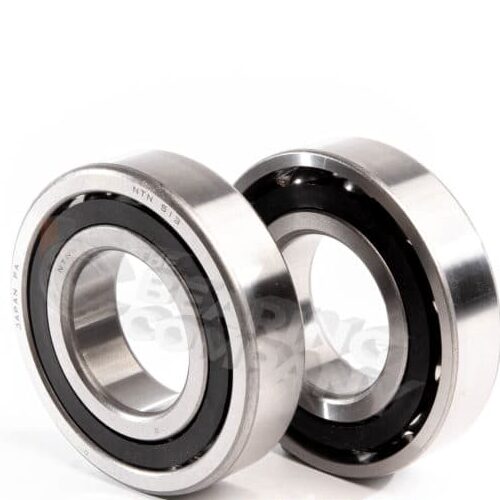
Bearings are an essential part of most machinery and in many avenues of day-to-day life. It then makes sense that there is a whole host of different types of bearings. Here at The Bearing Company, we have over 50 years of experience in this industry and know all there is to know about bearings and seals.
This extensive guide will explain the differences between each type of bearing, what they are best suited for, where they are commonly used, any drawbacks and important things to keep in mind when using them.
What are Bearings and Why are They Important?
Bearings are important units that are incorporated into various mechanical designs to ensure the smoothness of movement and reduce the levels of friction. This is achieved by how they adapt transferring forces and motion to support load. Because of this action, they reduce energy consumption by replacing sliding motion with low-friction rolling.
The load transfer is crucial in restricting the movement of parts to their predetermined directions and can be used for movements on radial, axial or a combination of the two.
They are important for ensuring the longer life and efficiency of both static and dynamic elements. Bearings act as a barrier to prevent metal-on-metal contact in relative motion. This reduces the level of friction, which keeps heat generation low and minimises the overall wear and tear of the applied area. Different types of bearings keep whatever machinery or item they are used in working at 100% for far longer.
Ball Bearings
A standard ball bearing is one of the more basic designs on offer. They use spherical balls held between two races to reduce friction between moving parts. The inner race rotates with the shaft while the outer race stays fixed. Because contact is limited to points between the balls and races, friction is lowered.
Ball bearings can support both radial and axial loads and are widely used in applications involving rotation or oscillation, such as electric motors. They are known for good wear resistance, low lubrication needs, low friction, long service life, easy replacement and low costs. However, they can break under shock, can be noisy and are unsuitable for heavy loads.

Deep Groove Ball Bearings
This type of bearing is the most common ball bearing used in the industry today, from agriculture to automotive to garden tools. Deep groove ball bearings are suitable for both radial and axial loads. The internal ball bearings are confined between two races via a retainer.
This design allows for rotational motion between the two races and creates a very low level of rolling friction. This produces limited noise and vibration, making them perfect for high-speed applications. Deep groove ball bearings are easy to install, just take care not to dent the races as you push them into place.
Self Aligning Ball Bearings
Self-aligning ball bearings differ from other types of ball bearings as they can handle misalignment in a system. They are typically made with double-row bearings, which are able to rotate freely. Letting the rolling elements rotate on their own bearing axis means this type of bearing can compensate for any deformation in the system.
They are commonly found in motorbikes, pulp/paper, railways, food and other general industries. Self-aligning ball bearings are a versatile solution for shaft and/or housing alignment issues.
Angular Contact Ball Bearings
Angular contact ball bearings are designed to take on heavier axial loads in both directions as well as radial loads. The inner and outer races are set differentially from each other along the bearing axis. This placement is what allows angular contact bearings to transfer the axial load throughout the housing.
This type of bearing sees wide use in agricultural equipment, gearboxes, pumps, CNC machining tools and the automotive industry.
Thrust Ball Bearings
Thrust ball bearings are perfect for managing axial loads and will rotate alongside parts of machinery, which can further help with that rotation. This type of bearing is a low-noise and low-friction option that is great for high-speed applications. They come in single and double direction options, depending on whether the load is unidirectional or bidirectional.
These are often found in aerospace, lifts, turbines, engines and other heavy-duty machinery.
Roller Bearings
Rather than smaller spherical bearings, roller bearings are made up of cylindrical rolling elements. A bearing is considered to be a rolling one when the length is only a little longer than its diameter. This type of bearing can support heavier loads as they are in line contact rather than point contact, which creates a larger surface area.
Although able to cope with heavier weights, the cylinders create more friction than the ball bearings, so they are slower overall.

Tapered Roller Bearings
Tapered roller bearings are a similar style to cup and cone bearings. They feature rollers positioned between two races that are shaped like hollow cones. If extended, the rollers and races would converge at a single point, allowing the bearing to support both radial and axial loads.
The ability to handle axial loads increases with the half-angle of the cone, enabling the bearing to function as both a thrust and radial bearing. To balance axial forces in both directions, tapered roller bearings are used in back-to-back pairs.
They are found in aircraft fuel pumps, wheel bearings, machinery shafts and in construction.
Spherical Roller Bearings
Regardless of whether it is radial or axial, a heavier load can be a far greater challenge and is more prone to misalignment. That is where spherical roller bearings come into their own. This type of bearing helps reduce maintenance costs and extend service life as its raceways are angled relative to the bearing axis, with the rollers having a spherical shape that fits the curved raceways.
These bearings are widely used in applications involving high loads, moderate to high speeds and potential misalignment. This includes off-road vehicles, pumps, industrial fans, marine propulsion systems, wind turbines and gearboxes.
Cylindrical Roller Bearings
This type of bearing is the simplest roller bearing in use. They produce low friction and offer excellent stiffness, axial transmission and a high durability ratio. Cylindrical roller bearings are available in single, double and four rows, and can be split or sealed. Split variants are great for hard-to-access areas, whereas sealed ones will last longer but need easy access to fit.
These are also perfect for heavy-duty uses like gearboxes, engines, turbines, construction, conveyors and mining equipment.

Thrust Roller Bearings
Thrust roller bearings are compact components essential for reducing friction between rotating parts. Unlike other types of ball bearings, they are designed to support high axial loads and allow the upper and lower sections to rotate independently, which requires differently sized races.
This design makes them ideal for heavy-load applications where axial forces are the most prominent. The unique structure ensures reliable performance in demanding conditions across various industries, including aerospace, marine, automotive, agriculture, mining, construction and heavy-duty machinery.
Needle Roller Bearings
Needle roller bearings are a unique type of bearing that has cylindrical rollers inside with small diameters resembling a needle. The lengths of these rollers will be four times their diameter, which allows for more of them to be set in the housing, creating a larger surface area, making them capable of handling heavier loads in a smaller package.
This type of bearing is used in compressors, automotive parts, drive transmissions, automatic gearboxes and a variety of pumps.

Plain Bearings
A plain bearing is just the bearing surface; there is no rolling element internally at all. It forms a sleeve mounted into a bore hole and is often referred to as a ‘sleeve bearing’. They can handle high loads and are used for reciprocating, sliding, oscillatory and rotational motion.
The sleeve bearing will remain fixed, so the internal material will have a low-friction rating, like copper alloys. This type of bearing is used in the automotive, construction, marine and agricultural industries and can accommodate some misalignment and multi-directional movements in both moving and static environments.

Magnetic Bearings
Magnetic bearings are advanced and interesting bearing solutions. They can also be classified as zero-wear bearings, as there is no contact during use. This type of bearing works by making use of magnetic levitation to hold the connected area in mid-air. This system has no limitations on the speed it can handle and can deal with misalignment without you noticing by adjusting the centre mass.
These bearings come in two forms, active and passive.
Active
Active magnetic bearings use electromagnets to achieve their zero-wear status. When the system detects a change in its sensors, it will adjust the current flow to that area to compensate. They are adaptive, reliable and predictive and are most commonly found in compressors and pumps and can see use in power generation, turbomolecular pumps and natural gas plants.
Passive
Passive magnetic bearings use traditional magnets with no current and create a consistent magnetic field around the shaft. Requiring no power and achieving the same low friction, high speeds is going to be crucial. But this technology is still in its infancy and requires precise design to create a functioning system.
This type of bearing is primarily used for steady levitation in environments of higher magnetic presence. More often, they are used as a safety backup to protect against equipment failure and can be used in conjunction with active magnets to handle static loading.
Fluid Bearings
Fluid bearings don’t exactly do what they say on the tin, because as well as fluid, they can also use gas in their housing unlike traditional bearings. The thin layer of pressurised air or liquid they use reduces sliding friction and provides better support for the rotating element. The initial cost of this bearing system is high, but it only ever makes contact at the start and end of its process, so it will last far longer than other systems.
This near-zero-wear bearing system comes in two types, hydrostatic and hydrodynamic.
Hydrostatic
Hydrostatic bearings work by having pressurised fluid forced externally between two moving elements. This is to form a gap between the moving parts and reduce friction and wear. The fluid itself is inserted into the system via a pump whose pressure can be controlled. This type of bearing can be used anywhere from machine tools to aircraft engines and even outer-space telescopes.
Hydrodynamic
Hydrodynamic bearings create a lubricated gap that is dynamically generated by the motion of the bearing itself. Suitable for both radial and thrust loads, these bearings rely on a film of oil or air to create a separating layer between moving parts.
A common example is the journal bearing, which operates by using the journal’s motion to draw lubricant into the space between the shaft and housing, forming a continuous wedge of fluid. This wedge supports the load and minimises direct contact. Hydrodynamic bearings are commonly found in power generation plants, petrochemical facilities, oil refineries, steam turbines and pumps.

How to Choose the Right Bearing for Your Application
Choosing the right bearing involves evaluating several key factors.
Start by identifying the load type: radial, axial or a combination of the two. Then work out its magnitude (light, medium or heavy). Ball bearings will work well for light to moderate radial or combined loads, while roller and tapered roller bearings are better for heavier or combination needs.
Be sure to account for physical constraints like available space and required precision. Ensure the bearing fits correctly and meets the application’s runout and rigidity tolerances.
Rotational speed is another major consideration. High-speed applications require low-friction bearings, often ball bearings or ceramic types, whereas roller bearings are more suitable for lower speeds.
Environmental conditions such as temperature, moisture and contamination should also influence your choice. Bearings with seals, special coatings or corrosion-resistant materials perform better in harsh environments. Lubrication depends on speed and environment, and accurate calculation of lubrication needs is important, as is proper sealing to retain lubrication and block contaminants.
Lastly, consider maintenance, cost and longevity. Consult service manuals or one of our specialists at The Bearing Company for complex applications to ensure optimal performance and lifespan.
Shop Bearings with The Bearing Company
This guide will have explained the different types of bearings that are used throughout various levels of industry in the world. Are you looking for high-performance, durable bearings you can trust? The Bearing Company has used our over 50 years in the business to cultivate a range of premium bearings that are engineered for precision, reliability and long-lasting performance across all applications.
Whether you’re doing odd jobs around the house or in manufacturing, automotive or industrial maintenance, we have the perfect solution to keep your equipment running smoothly. Don’t let downtime slow you down. Explore our wide selection of bearing solutions today and experience unmatched quality and speedy delivery. Contact us and order now to get your machinery moving with confidence!