 Free Tracked Shipping on all Orders Over £50
  Premium & Budget Product Ranges
 Bespoke solutions
  ISO 9001: 2015 certified
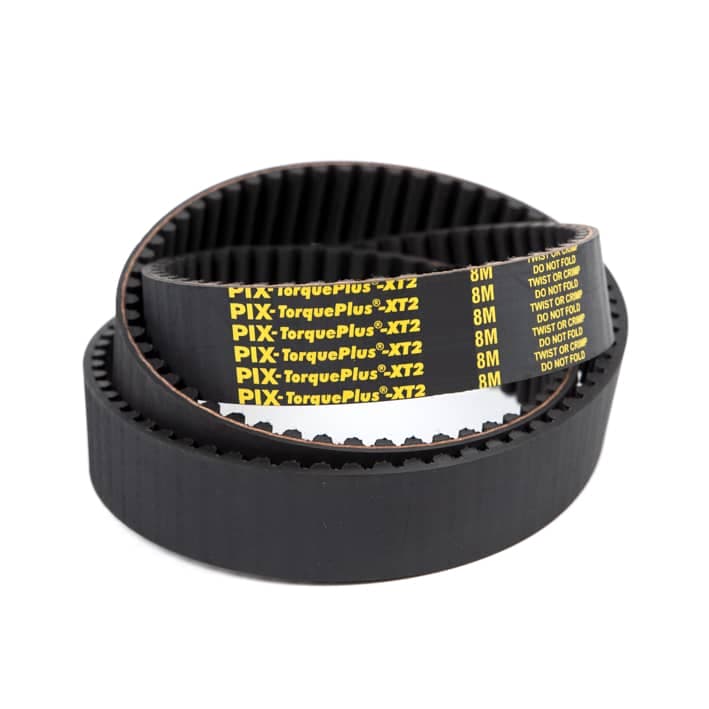
A timing belt is a crucial component in many machine transmissions and automotive engines, ensuring harmonic movement between the camshaft and crankshaft. Beyond vehicles, industrial timing belts are toothed, synchronous drive belts designed for accurate power transfer and precise coordination in machinery, robotics, and CNC systems. By meshing with matching pulleys, they prevent slippage and maintain a constant speed ratio during operation.
This guide explores what timing belts are in more depth, including how they work, the different types available, their role in both automotive and industrial settings, recommended replacement schedules, and common issues to look out for.

What is a Timing Belt?
In industrial machinery, a timing belt is a reinforced rubber belt that synchronises the rotation of shafts, ensuring precise movement of mechanical components. Unlike automotive applications, these belts are critical for conveyor systems, packaging machines and production lines & robotics where exact timing is essential.
Learn more about our high-quality industrial timing belts here and discover The Bearing Company’s expertise in supplying reliable timing belt types for all machinery needs.
What are the Uses of Timing Belts?
Regardless of whether the timing belts are used in an industrial, automation or automotive setting, their use cases are the same. A timing belt is for positive power transmission, precise positioning and synchronisation.
They are commonly used to synchronise rotating shafts in conveyor systems, ensuring materials move smoothly and consistently along production lines. In packaging machines, different timing belt types help coordinate multiple components, from filling to sealing, maintaining exact timing to prevent jams or errors.
They are also used in printing presses, textile machinery and automated assembly equipment, where accurate motion control is essential. By providing reliable, slippage-free power transmission, timing belts improve efficiency, reduce wear on other components and maintain consistent, efficient output across industrial operations.
How Do Timing Belts Work?
A timing belt uses a series of precisely engineered teeth on its inner surface that mesh with matching grooves on a pulley system. This positive engagement ensures there is no slippage and that both power and motion are transferred in exact sync between shafts, crucial for accurate machine timing and repeatability in industrial systems.
The belt’s reinforced construction (often with steel or high‑tensile fibres) keeps its length stable and tension consistent, allowing smooth, efficient operation in conveyors, packaging lines and other automated equipment.

Types of Timing Belts
There are several types of timing belts used in industrial applications, each designed to meet different performance requirements. Open-ended timing belts are supplied in long rolls and cut to the desired length, making them ideal for all customised linear motion systems. Spliced and welded belts are formed into endless loops from roll stock, providing flexibility and cost efficiency for general conveyor and material-handling tasks. Truly endless belts are manufactured as a single continuous piece, offering the highest durability and resistance to fatigue for heavy-duty drives. Timing belts also vary in tooth profile and pitch, including high torque and standard designs, to suit different load capacities and precision needs. So the question is, what is a timing belt and what timing belt is perfect for me? It is a little more complicated, and all depends on your needs and requirements.
Timing Belt Materials
Rubber
Rubber timing belts are a popular choice across industrial machinery due to their inherent flexibility, durability and cost-effectiveness. They tend to be reinforced with other materials like kevlar or fibreglass that support its increased strength while maintaining its elasticity. These types of timing belts are also an ideal choice for applications that require a degree of shock absorption and quiet running. Conveyors, smaller machines and systems that need smooth, vibration free movement make great use of rubber timing belts.
Polyurethane
Polyurethane timing belts offer high resistance to wear, chemicals and oils, making them suitable for harsh industrial environments. They are more rigid than rubber alternatives and provide precise, slip-free engagement with toothed pulleys, ideal for high-speed and high-precision applications like packaging, automation and robotics. Their durability levels extend maintenance intervals, and they handle repeated flexing without cracking or stretching.
Fabric
Fabric timing belts are reinforced with woven fibres that are embedded into the belt material itself, offering excellent levels of both strength and stability. They are lightweight and flexible, making them suitable for small to medium industrial machinery where consistent motion and minimal maintenance are priorities. Fabric belts are particularly useful in applications requiring quiet operation, reduced vibration and precise timing without the higher cost of polyurethane or specialised belts.
Understanding Timing Belt Tooth Profiles
Timing belt tooth profiles determine how the belt engages with pulleys, affecting precision, load capacity and durability. Common profiles used in industrial applications include:
- Trapezoidal (Standard or ST): The classic tooth shape, ideal for general-purpose applications. It provides reliable engagement but may experience some slippage under high torque.
- HTD (High Torque Drive): Curved tooth profile designed to reduce backlash and distribute load more evenly, suitable for high-torque and high-speed machinery.
- PIX Belts (XT2 Range): TX2 timing belts feature an advanced tooth profile for smooth and precise pulley engagement.
- GT (Gates or GT2/GT3): Modified curvilinear profile offering smooth operation and minimal vibration, commonly used in robotics and precision equipment.
- Round Tooth: Simplified profile for low-speed applications, reduces noise and wear, often used in light-duty machinery.
- Poly Chain® or T-series: Advanced tooth shapes with enhanced strength and wear resistance for heavy-duty and high-performance drives.
Each profile is selected based on load requirements, speed and desired accuracy of the machine. Once you have the details of where the belt is needed, what it will be moving and what type of timing belt teeth you need, you’ll be able to tailor the perfect timing belt solution.

When to Replace a Timing Belt?
Timing belts should be replaced before they completely fail to prevent more severe damage to machinery leading to extended production downtime. In industrial settings, belts naturally wear over time due to heat, friction and continuous use. Replacement schedules should be based on operating hours, environmental conditions and manufacturer guidelines rather than waiting for visible signs of failure.
Typical indicators that a timing belt needs replacing include cracking, fraying, hardening of the belt material, unusual noises or slipping during operation. Regular inspections and proactive replacement during scheduled maintenance will help avoid unexpected breakdowns, reduce future downtime and protect other machine components and products from damage or any workers from being injured due to faulty components.
How Do I Choose the Right Timing Belt?
Choosing the right type of timing belt requires taking a few different measurements into account as well as its general usage. You will first need to match the exact pitch between each of the belts teeth, its overall length, the width, how many teeth it has and what kind of profile the teeth themselves have.
It is then best to factor in what the torque requirements and load requirements the timing belt will be subjected to. Then find out the material of the timing belt itself, which should coincide with any environmental factors in its operating area. Both automotive and industrial machinery applications may also have a part number either on the belt itself that can then be easily found on the manufacturers page.
Shop Timing Belts at The Bearing Company
The different types of timing belts are essential for precise, reliable operation in industrial machinery and regular maintenance or replacement is key to avoiding downtime. This guide should have given you everything you need to maintain and identify which one you have and give you a more comprehensive answer to what timing belts are.
Here at The Bearing Company, our expert team offers a wide range of high-quality timing belts, as well as other belt types including mower belts, Vee and wedge belts, ribbed belts and automotive belts. Browse our full belt selection today to find the perfect solution for your machinery and keep operations running smoothly.